
The Marketing Budget Problem
You know you need to invest in marketing. New customers don't appear from nowhere, and relying on referrals alone puts a ceiling on growth. But when someone asks how much you should spend, the answer most people get is some version of "it depends", which isn't helpful when you are trying to make a decision.
Too little, and the marketing spend does not move the needle. Too much, and you are burning cash with no clear picture of the return. Most service business owners end up picking a number that feels reasonable and hoping for the best.
This article walks through a simple, math-based approach to figuring out exactly what you should be spending on marketing, and more importantly, what actually drives that number down.
Industry Averages (and Why They Fall Short)
There are widely used benchmarks for marketing spend as a percentage of revenue. B2B companies typically target 5-10%, B2C companies often spend 10-20%, and professional services firms tend to land in the 6-12% range.
The problem is that these are averages across hundreds of businesses with completely different growth goals, margins, competitive landscapes, and sales processes. A company trying to hold steady at current revenue has different needs than one trying to double in three years. Plugging your revenue into a percentage formula tells you what other businesses spend on average. It does not tell you what you need to spend to hit your specific goal.
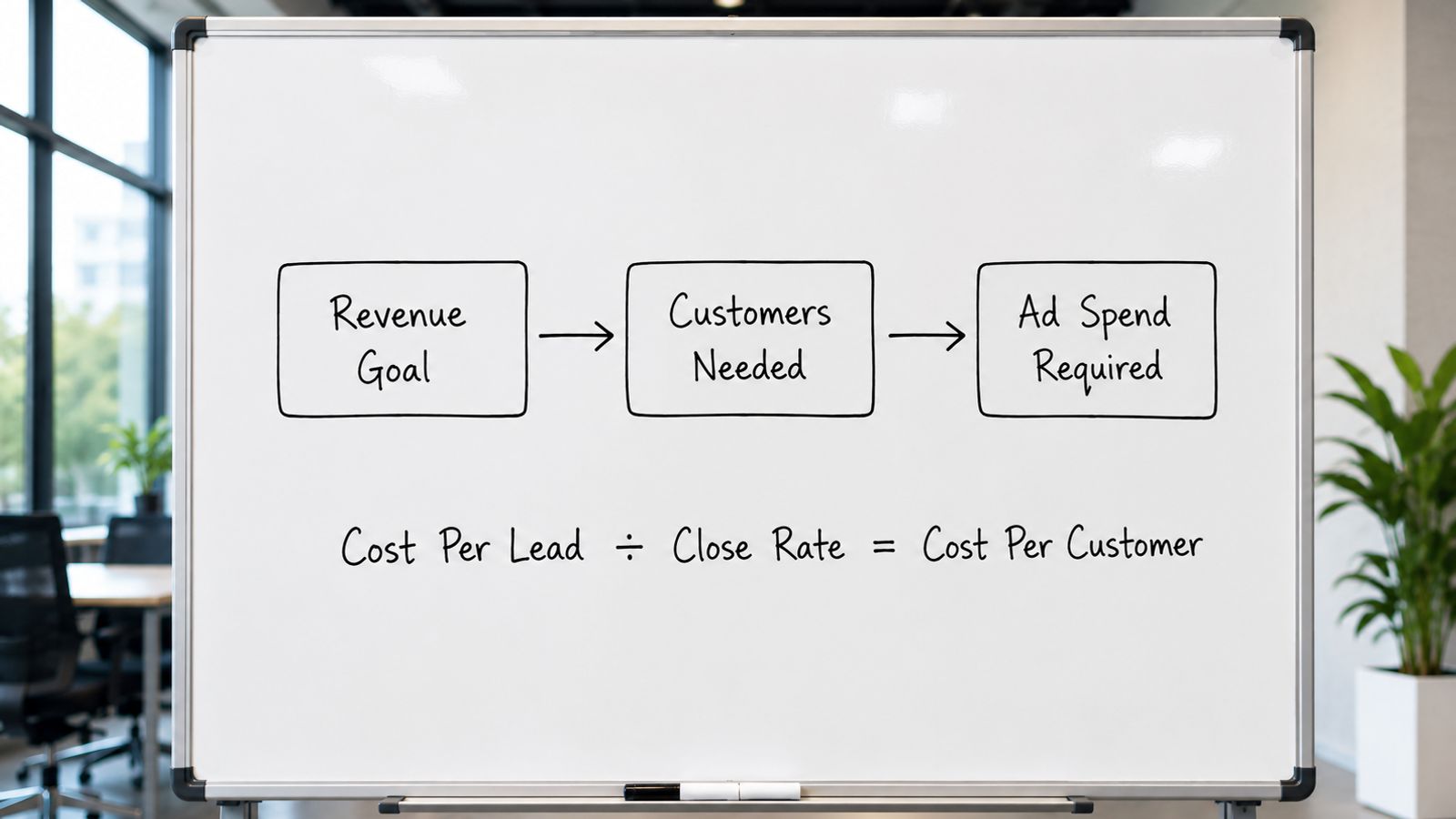
A goal-based approach is more useful. Start with what you want to achieve and work backward to the ad spend required to get there.
How to Calculate the Ad Spend for Your Goals
Before getting into the math: this framework is intentionally simplified. Comprehensive analysis involves additional costs like agency fees, creative production, and sales labor that are not captured here. What this gives you is a directional starting point, a way to anchor your budget to actual business outcomes rather than a guess. Use it to get your footing, then refine as you gather your own data.
Step 1: Figure out how many new customers you need.
Start with your revenue growth target. If you want to grow by $500,000 this year, how many customers does that require?
For businesses with one-time or project-based work (moving, excavation, construction services), divide your growth target by your average job size. A $500K growth goal with a $2,500 average job means you need 200 new customers.
For businesses with recurring customers (portable sanitation, landscaping, property maintenance), divide your growth target by the average annual value of a customer. A $500K growth goal with customers spending $5,000 per year means you need 100 new customers.
Once you have the annual number, divide by 12. That is your monthly new customer target.
Step 2: Figure out your cost per acquired customer.
Cost per acquired customer = Cost per lead / Close rate
Your cost per lead is what you pay to generate a single inquiry from a potential customer. Ad platforms like Google Ads and Meta make this easy to track. Your dashboard will show you cost per lead directly. If you do not have your own data yet, here are rough benchmarks to start with:
- Google Search Ads): $30-80 per lead
- Meta / Facebook Ads: $20-60 per lead
- Local SEO / organic: $10-30 per lead (lower cost, longer to build)
Your conversion rate is the percentage of those leads that become customers. This counts every lead generated, how many turn into a paying job, not just the ones you spoke with or quoted. A 20% close rate means 1 in 5 inquiries turns into a job.
Put those together: if your cost per lead is $50 and your conversion rate is 20%, your cost per acquired customer is $250 ($50 / 0.20).
Step 3: Multiply by your monthly customer target.
If you need 17 new customers per month and each one costs $250 in ad spend to acquire, your monthly ad budget is $4,250, or about $51,000 per year.
That's your number, based on your goal. Not an industry average.
The Levers That Lower Your Costs
Once you know the formula, you can see exactly what pulls that budget up or down. For service businesses specifically, there are two variables that matter most: cost per lead and close rate.
Reducing cost per lead
Marketing drives this number. The three main levers for service businesses are ad creative, targeting, and your lead magnet.
Ad creative is the headline, imagery, and offer in your ads that determines whether someone clicks or scrolls past. Most businesses run one or two ad variations and leave them alone. Testing different headlines, different calls to action, and different value propositions on a regular rotation is one of the most reliable ways to bring cost per lead down over time. A weak creative can easily cost 2-3x what a strong one does for the same result.
Targeting determines who sees your ads. Running broad campaigns wastes budget on people who will never buy from you. Tightening your audience by geography, job title, industry, or behavioral signals means more of your budget reaches people who are actually in-market.
A lead magnet gives potential customers a reason to raise their hand before they are ready to buy. A free service, a downloadable guide, an ROI calculator, or a short consultation lowers the barrier to entry and brings more leads into your funnel at a lower cost per contact. Not all of those leads will convert immediately, but they give you an audience to nurture.
Realistically, meaningful improvement across all three of these levers will typically yield incremental gains. The bigger leverage usually sits on the other side of the equation.
Improving your close rate (this one is underestimated)
Here is what most service businesses miss: ad platforms give you excellent data on cost per lead. It is easy to track, easy to optimize, and easy to talk about. Conversion rate, on the other hand, lives in your sales process. Most businesses are not tracking it closely, so it never gets the same attention.
The result is that service businesses pour money into generating more leads while the underlying conversion problem goes unaddressed. They're filling a leaky bucket.
The good news is that for service businesses, conversion rate is often where the biggest gains are available. The three factors with the most impact are:
- Response time. Leads that get a response within 15 minutes are dramatically more likely to convert than those that wait hours. Studies consistently show that the first business to respond wins the job more often than not.
- Follow-up persistence. Most leads require 4-6 follow-up touchpoints before they book. Most businesses give up after one or two. Staying in the conversation is one of the highest-leverage things you can do.
- Quality of the response. A professional, accurate, personalized reply builds trust immediately. A generic auto-reply or a slow, vague answer loses the job before it starts.
Service businesses that work on these three things consistently see their close rates double or triple. Go back to the formula: if your close rate goes from 20% to 40%, your cost per acquired customer drops from $250 to $125. That cuts your required ad spend in half to hit the same growth goal while also improving customer experience and retention.
How HyperRep Helps With the Conversion Side
HyperRep helps site services businesses respond faster, follow up consistently, and handle lead conversations professionally at scale, the three pillars that move close rates. We also track your leads and conversions so you can calculate your true cost to acquire a customer, giving you a real number to base your marketing spend decisions on instead of a guess.
If you're generating leads but not converting them at the rate you should be, we can help.