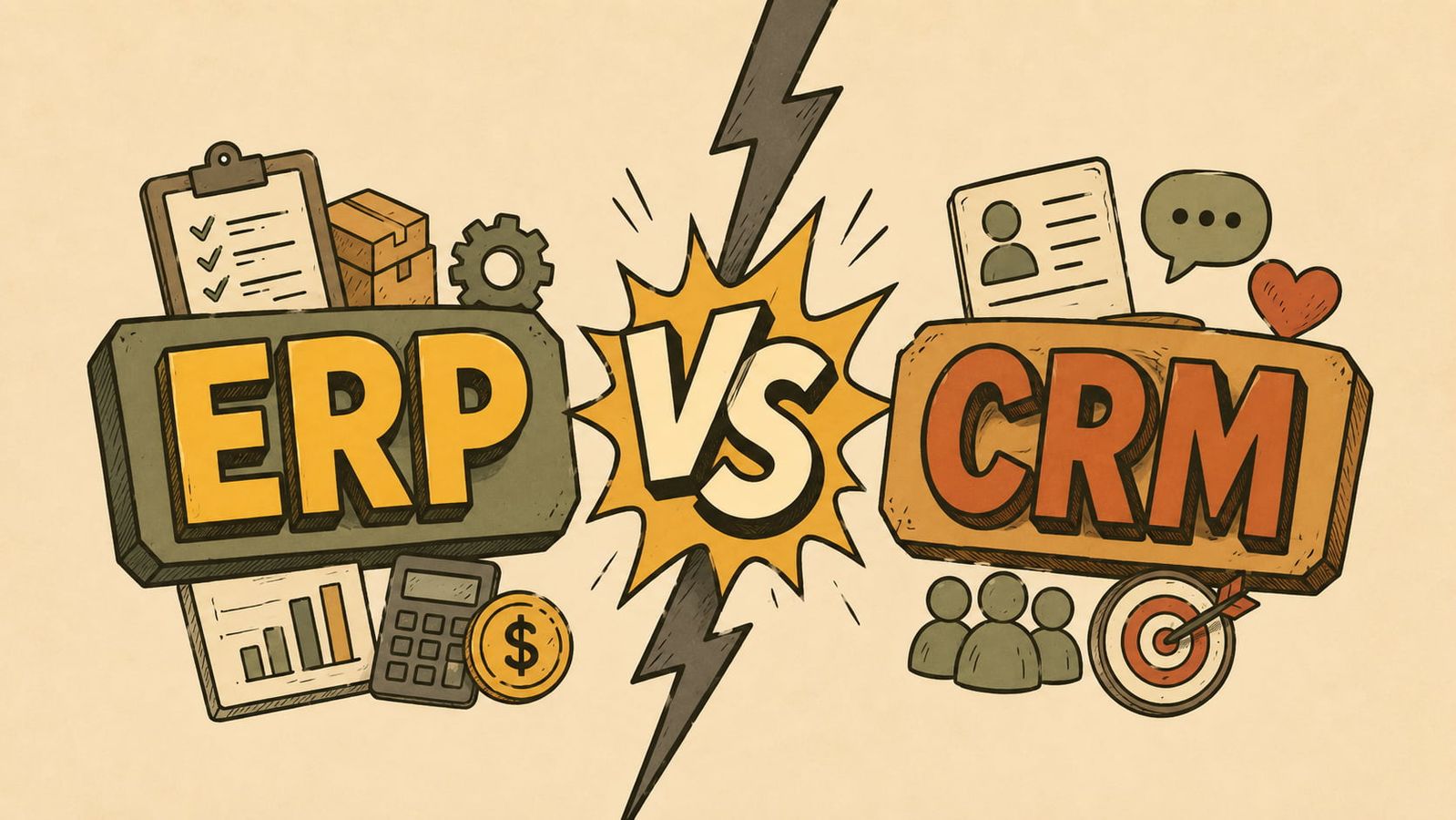

If you run a site services business with scale, multiple locations, a growing fleet, you probably have a solid ERP. It runs your billing, your fleet, your routing, your accounting. What most companies in this industry don't have, or have and barely use, is a real system for the sales side. That gap is where a huge amount of untapped opportunity sits. Not in the trucks or the routes, but in the office and on the sales side, in the leads that get a slow follow-up, the quotes that never get a second touch, and the customers nobody circles back to.
This article breaks down the difference between an ERP and a CRM, why site services companies tend to have one but not the other, and where even a good CRM stops being enough for this industry.
What Your ERP Is Actually Built For
An ERP (enterprise resource planning system) manages everything that happens after someone becomes a customer. That's service scheduling, routing, fleet and asset tracking, billing, accounts receivable, and reporting on profit and loss. If you're in site services, this is probably the backbone of your operation, and for good reason. You can't run a fleet of trucks and thousands of service stops without it.
But the ERP starts its job after the deal is won. It has no real concept of a prospect, a marketing source, or a sales stage. It doesn't care how a customer found you or how many touches it took to close them. It just needs the contract signed so it can start scheduling drops and pickups.
That's a huge blind spot for a company running at this size. If most of your growth still comes from word of mouth, a few reps working the phones, and whatever leads happen to land in an inbox, you're running a large operation without a real view of your sales pipeline.
What a CRM Actually Does, and Why It Matters
A CRM (customer relationship management platform) lives earlier in the customer journey than your ERP does. Its job is to help you win more of the prospects you're already talking to and give you visibility into how that happens. A good CRM tracks:
- Which marketing campaigns and channels actually produce customers, not just leads
- Where each opportunity sits in your sales process, from first contact to signed contract
- Which reps are converting well and which ones need coaching
- Every call, email, and text tied to a prospect, so nothing falls through the cracks
- Win rates and loss reasons, so you can see patterns instead of guessing
This matters because most site services companies are leaving money on the table simply from disorganization, not lack of demand. A missed follow-up, a quote that never got sent, a lead that sat for three days before anyone called it back. These are the things that quietly cap your growth. A CRM gives you the process and the data to fix that. It tells you where your customers are actually coming from, so you can spend your marketing dollars on what works instead of what feels right.
The problem is that most companies in this space either never adopt one, or they buy one, set it up halfway, and let it collect dust after the first few months.
Where CRMs Fall Short for Site Services Companies
Here's the part that doesn't get talked about enough. Even when a site services company does adopt a CRM, it usually doesn't deliver what they hoped for. A few reasons why:
They require a trained sales team to actually use them. Most CRMs are just a tracking layer. They organize information a rep puts in, they don't help that rep sell. If your team isn't already disciplined about logging calls, updating stages, and following a defined process, the CRM turns into an empty database with a login screen nobody uses.
They track the process, they don't run it. A CRM will remind you a follow-up is due. It won't write the follow-up, send it, or catch the lead that's gone quiet for two weeks. Every action still depends on a human remembering to do it, and in a busy office with a handful of reps juggling calls and quotes, things get missed constantly.
Platforms like HubSpot and Salesforce are built for every industry, not yours. They're powerful, but that power comes with a setup burden most site services companies aren't equipped for. You end up paying a consultant to configure pipelines, fields, and automations that were never designed with quoting a portable restroom contract or a construction dumpster rental in mind. Months later, half the team still isn't using it right.
They usually don't talk to your ERP. This is the big one. Most CRMs have no integration with the systems that run your day to day operations. That means no help with what happens after the sale closes, like flagging upsell opportunities, winning back a customer who churned, catching an account that's gone quiet, or getting ahead of an overdue invoice before it becomes a collections problem. The CRM and the ERP end up as two disconnected systems, and someone on your team has to manually bridge the gap, if anyone does at all.
The Real Fix: Sales Automation Built for This Industry
The answer isn't just "get a CRM." It's a platform built specifically for site services that actually does the work, not just tracks it. That means:
- The system actively drafts quotes and follow-ups for your reps to review and approve, instead of leaving reps to write everything from scratch
- You get back to customers before your competitors do, and that speed alone wins you more deals
- No expensive, time consuming sales training needed. Every rep sells like your best rep, even on day one, because the system carries the process instead of leaving it up to individual skill
- Nobody's stuck on data entry, because the system captures it from the conversation itself
- Quotes go out faster and win more often, with pricing built for how this industry actually sells
- Nothing is lost after the sale either, because it connects to your ERP and keeps upsells, win-backs, and overdue AR on your radar
This is a different category from a traditional CRM. It's not a filing cabinet for your sales activity. It's a system that does a meaningful share of the selling and follow-up work itself, built around how site services companies actually operate.
Getting there isn't simple. It takes real integration work, an understanding of how quoting and pricing work in this industry, and a system smart enough to know when to nudge a rep and when to just act on its own. But the companies that get it right stop losing deals to slow follow-up and start seeing exactly where their growth is coming from.
Why We Built HyperRep
This is the exact gap we saw when we started. Site services companies had ERPs running their operations and little to nothing helping them win and grow the customer relationships that fuel them. That's why HyperRep exists: a sales automation platform built specifically for site services, one that doesn't just fill the CRM gap most companies never fill in the first place, but also fixes the exact shortfalls listed above, like requiring a trained team, running on manual data entry, and having no connection to your ERP. If this sounds like where your company is stuck, that's exactly the problem we set out to solve.
Book a call with our team to learn more about how it works for your business.