
If you run a site services company, you already know this: before a customer calls you, they Google you first. And what they find on that search page decides whether the phone rings or goes to a competitor.
This article breaks down exactly how to earn more Google reviews, the right way, so your business shows up first and wins the call before it's even made.
Why Google reviews decide who gets the job
97% of consumers read online reviews before choosing a local business, and Google is where the vast majority of them look first. On top of that, 68% of people say they'll only use a business with four stars or higher, and that bar keeps rising every year (Source, as well as more great stats on Google Reviews: BrightLocal's 2026 Local Consumer Review Survey).
Reviews don't just influence the decision either. They influence whether the prospect ever sees you in the first place. Google's local ranking algorithm weighs review count, review recency, and review content when deciding who shows up in the map pack for searches like "portable toilet rental near me" or "construction dumpster rental [city]." More reviews, especially recent ones with relevant keywords, tell Google you're active, trusted, and worth surfacing above the competition.
So the math is simple. More reviews means higher rankings. Higher rankings mean more visibility. More visibility plus more reviews means more leads. And it all starts with a review strategy that most site services companies still don't have.
Step one: build an experience worth ranting about
Many companies assume good reviews come from good service, and stop there. But "good" isn't what makes someone stop what they're doing and write a review. Only strong emotion does, whether that's frustration or delight. This is why most reviews are either 5 stars or one star. If you want more reviews, you need customers who feel strongly enough to say something.
Most site services companies have the field operations down. Equipment shows up on time, it's clean, it works. That's the must-have foundation for a good customer experience. But it's also expected, so it won't get you a five-star review on its own. Customers don't rave about things going as planned. They rave about things that surprise them.
We reviewed the Google reviews for one of the largest site services companies in the country to find the real pattern. Over 70% of reviews, both good and bad, mentioned the office team specifically. Not the driver. Not the equipment. The office.
That's the differentiating factor that turns a good experience into a great one: how the office handled the account. Did they answer the phone quickly? Was billing simple and accurate? Did they follow up before you had to chase them down? Were they pleasant to deal with when something went wrong? These are the details that show up in reviews, because they're the details customers actually remember.
If your field operations are solid but your office experience is inconsistent, you're leaving five-star reviews on the table. Before you ask for more reviews, make sure the experience behind the scenes, quoting, billing, follow-ups, and responsiveness, is consistently excellent. That's the foundation everything else is built on.
Step two: ask for reviews systematically, not randomly
Once the experience is strong, the second half of the equation is simple: ask. But most companies get this wrong too. They ask inconsistently, usually when someone happens to remember, which means most great experiences never turn into a review at all.
A real review strategy runs on a system, not a memory. Every customer who has a positive interaction gets asked, every time, at the moment they're most satisfied. That moment usually comes right after a job is completed well, an issue gets resolved fast, or an invoice comes through clean and on time. Ask too early and the customer hasn't had the full experience yet. Ask too late and the moment has passed.
One more lever that works well: tie a small incentive to the ask. For example, some leaders give their team a bonus when a customer specifically mentions that team member's name in a five-star review. When you tell the customer this, it changes how they see the request. The ask stops feeling like a favor and starts feeling like a way to actually help someone on your team get recognized. That reframing gets more people to follow through, and it gets more detailed, specific reviews mentioning real people and real interactions, which is exactly what Google's algorithm and future customers respond to.
Just make sure the incentive structure is real before you mention it to a customer. If you tell someone their review helps a team member earn a bonus, that needs to actually be true.
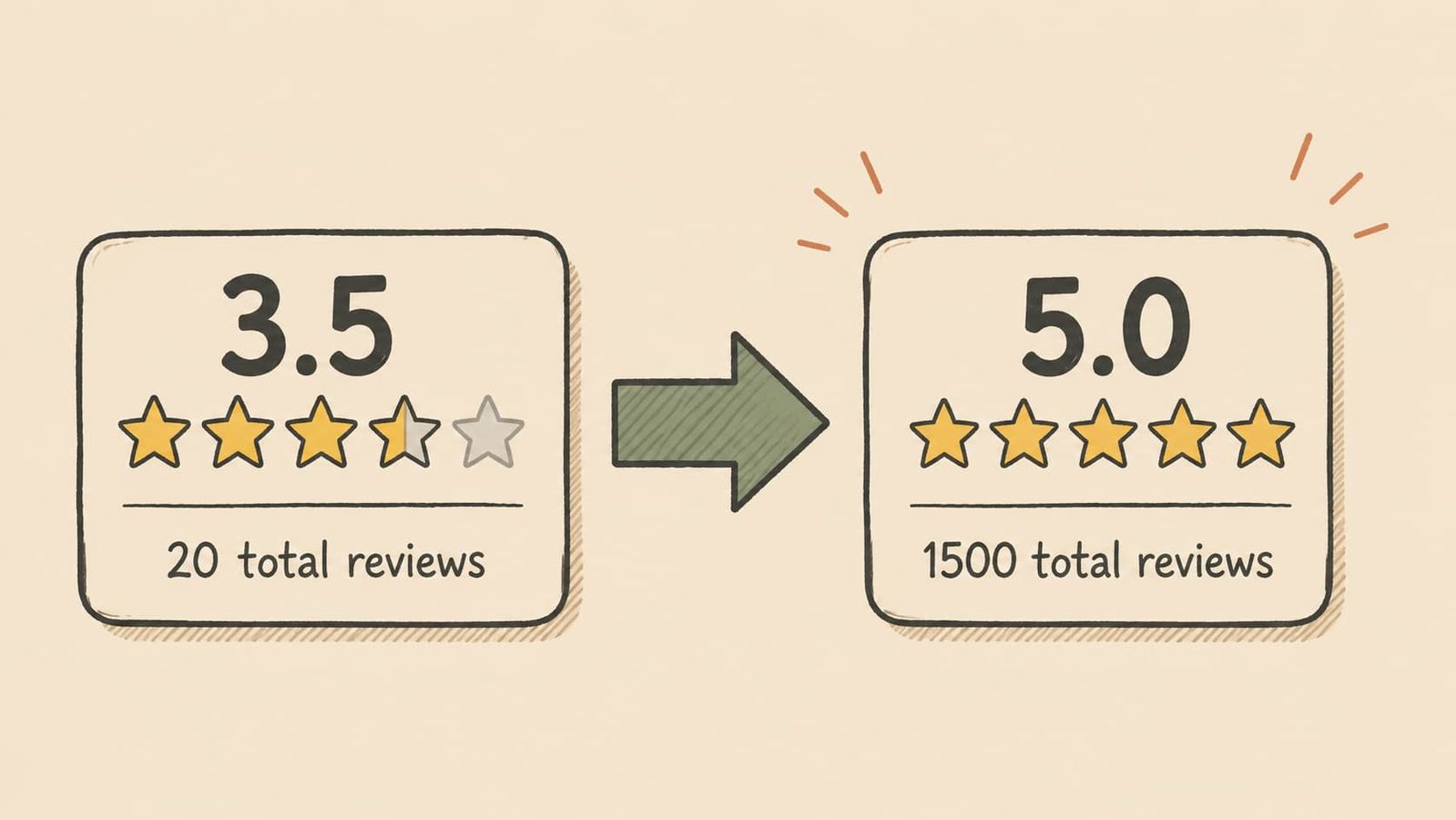
Consistency is really the whole game here, especially once you're operating across multiple locations or regions. This is the actual difference between the site services company sitting at 20 Google reviews and the one sitting at 1,500. It's rarely that one company had dramatically better jobs than the other. It's that one asked every time, at every location, for every satisfied customer, and the other asked occasionally when someone thought of it. Over hundreds of jobs a month, that gap turns into years of missed reviews. If review generation depends on individual reps or office staff remembering to ask, it will always be inconsistent, and inconsistency shows up directly in your review count and your local search rankings.
How HyperRep helps
HyperRep helps site services companies deliver a faster, more consistent office-side experience: quoting, follow-ups, and answers to customers, handled quickly and the same way every time, across every location. As a bonus, it also identifies the right moment to ask each satisfied customer for a review, automatically, so it happens every time instead of when someone remembers.
If you want to turn more of your jobs into five-star reviews, reach out to our team and we'll show you how it works for your business.