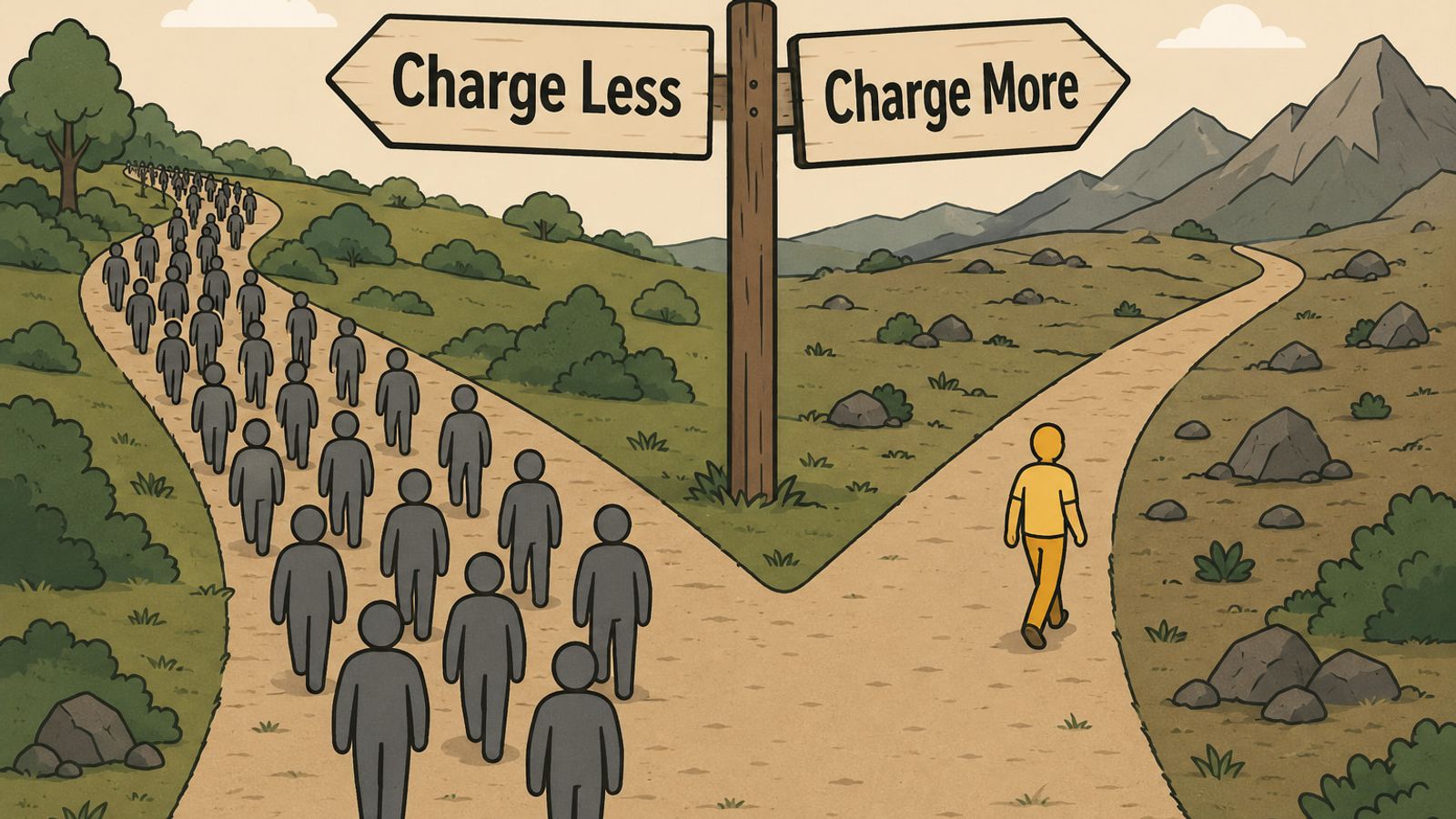

Nobody Starts a Business to Get Into a Price War
Nobody starts a business to make no money or thin margins. Nobody wakes up on a Monday morning thinking, "I can't wait to get into a pricing war today." The goal was always growth, stability, a business that actually works for the people running it.
But a pattern sets in for a lot of service businesses: a competitor drops their price, you match it to win the job, they drop it again, and now everyone in the market is fighting over the same customers at margins that barely cover costs. The business gets busier, and somehow there's still not enough left over. Not enough to reinvest, to take a real distribution, or to grow the way the original plan called for.
This is market pressure. It shows up in almost every service category, and it tends to intensify as an industry matures. The businesses that escape it aren't necessarily working harder, they've just figured out a different way to compete.
Why Price Competition is a Losing Game
Competing on price is a race to the bottom, and the winner is whoever can survive on the thinnest margins.
When price is the primary reason customers choose you, you attract customers who will leave the moment someone else is cheaper. No loyalty, no reputation, no moat. And worse, you end up taking on high-volume, low-margin work that consumes your team's capacity and leaves nothing for the jobs that actually move the needle.
Margins fund everything. Competitive wages for employees, equipment upgrades, technology, marketing, and growth. When margins compress, all of that shrinks. The business becomes a treadmill.
There are two root causes behind chronic price competition in service businesses: insufficient demand, and a lack of differentiation. Both are solvable.
Use Excess Demand to Force Your Prices Up
Think about the following: what would you do if your demand increased by 10x tomorrow?
More specifically, if ten times as many qualified customers wanted to buy your offering and your capacity stayed the same, what would happen? According to basic supply and demand, you'd raise your price. You'd have to. You can't service everyone, so price becomes the filter. The market forces your price upward until the volume of sales falls back in line with what you can actually deliver.
What many business owners do when demand spikes, though, is simply turn customers away. They stop marketing. They pause lead generation. They try to manage the workload by reducing the number of people asking to buy. That's the wrong move. When you have more demand than you can fulfill, you keep demand generation running at full capacity and raise your prices until supply and demand come back into balance. More demand always creates more leverage.
Here's what that looks like operationally: when you raise prices, your lead-to-sale conversion rate will go down. That's the point. You're trading volume for margin. A higher price filters out the price-only buyers and keeps the customers who are choosing you for the right reasons.
There are two levers to increase demand:
1. Lead volume. More qualified prospects entering your pipeline means more opportunities. Organic search, paid advertising, referrals, outbound outreach. Any channel that puts your business in front of the right buyers.
2. Conversion rate. Of the prospects already coming to you, how many become customers? Improving response time, follow-up consistency, and the pre-sale experience dramatically affects how many leads close, and at what price point.
Both levers compound. More leads at a higher conversion rate produces disproportionately more revenue, not just incremental growth. Read more on how to improve each of these here.
Differentiate Your Offerings
There will always be buyers who shop purely on price. Nothing changes that. They call around, take the lowest number, and move on. Those aren't the customers worth competing for. Let someone else have them.
What often surprises service business owners is how many rational buyers will spend well more than the cheapest option, as long as there's a real reason to.
The question to ask: what would allow you to charge 50% more than you do today and still win the job?
The fastest way to find the answer is to read your reviews. What do customers actually say when they leave five stars? Almost never "they were the cheapest." More often:
- "The customer service was great, [name] was so helpful"
- "I never had to chase them down or wonder what was happening."
- "They just took care of everything. I didn't have to think about it."
In site services businesses, the offering itself is often the same from the outside. What separates companies is the experience. And in most service categories, that comes down to three things:
Communication. For many customers, the only real interaction they have with a business is how it communicates. How fast it responds. Whether it follows through. Whether they feel informed. This is often the entire customer experience.
Quality. This one seems obvious, but it often gets overlooked as a differentiator because owners assume everyone is delivering it. They're not. Quality means the work is actually done right, and the job looks the way a customer would want it to look if they were standing there watching.
Reliability. Customers want a provider who just takes care of it, every time, without them needing to check in. That consistency is hard to replicate at scale, and customers will pay a significant premium for it.
Most businesses that have been operating for a few years already have these differentiators in some form. The gap usually in definition and operationalization. What exactly is the standard? How is it delivered consistently as the team grows?
And critically: is it visible to the customer before they ever ask for a price?
Before a prospect hears your number, they should already understand why you're worth more. This can be done through social proof (reviews, testimonials, etc.), a buttoned-up sales process that shows your company's standard, etc. The price conversation lands completely differently when it comes after the customer already believes you're the best option. That's where differentiation wins you the new customer.
But the bigger payoff comes after the sale. When customers actually experience what makes you different - consistent communication, reliability, the feeling that someone is just handling it - the relationship changes. They stop shopping around at renewal time. They don't flinch when you raise prices. They send referrals without being asked. Lower churn, higher lifetime value, and a referral engine that compounds over time are worth far more than any individual sale won on price.
Where HyperRep Fits In
HyperRep helps site services businesses improve on both fronts. We improve and accelerate customer communications so your team responds faster, follows up consistently, and delivers the kind of experience that earns five-star reviews and repeat business. That translates directly into stronger differentiation and a higher conversion rate on the leads you're already getting.
If you're ready to stop competing on price and build a business that consistently wins on value, we'd like to help. Learn more here.