Steve Jobs' "Bicycle for the mind" Analogy
Steve Jobs was both a product guy and a philosopher about what technology was for. And one idea followed him from the earliest days at Apple all the way through his return to the company decades later.
It started with a study he read in Scientific American in the early 1970s. Researchers measured the energy efficiency of locomotion across species (how much fuel each animal burned to travel a kilometer). The condor took first place. Humans came in about a third of the way down the list. Jobs described it as "not too proud a showing for the crown of creation."
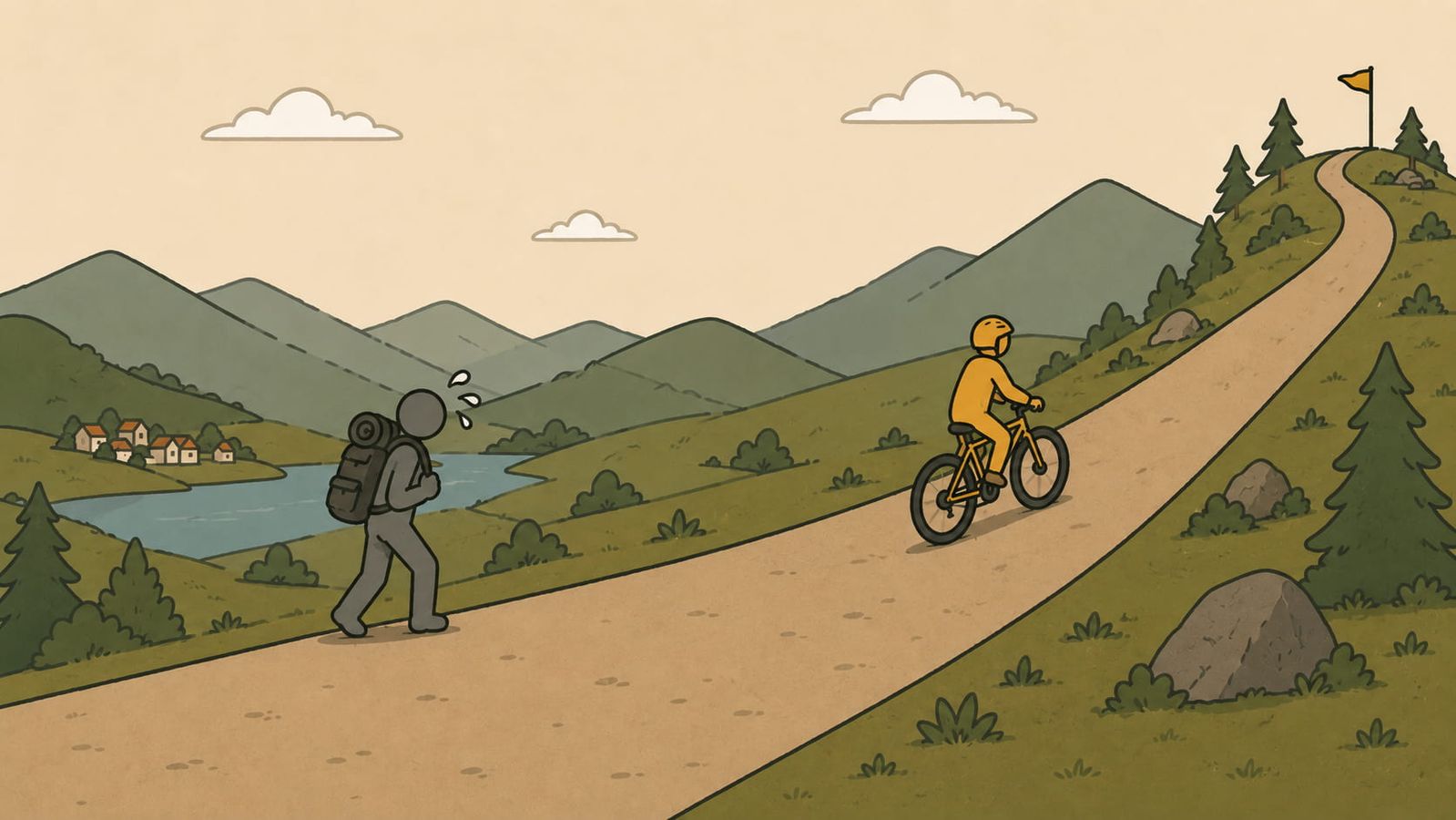
Then someone had the imagination to put a human on a bicycle. A person on a bicycle blew every other animal out of the water.
Jobs told this story over and over again because it captured something he believed at his core. In a 1990 interview, standing in front of a whiteboard, he said: "I think one of the things that really separates us from the high primates is that we're tool builders... What a computer is to me is it's the most remarkable tool that we've ever come up with, and it's the equivalent of a bicycle for our minds."
Watch the full video of Steve Jobs making telling the story here.
What Jobs Believed About Tools
Jobs said this at a moment when a lot of people were afraid. The personal computer was spreading fast, and the fear was the same fear that surrounds every major technology shift: that the machine was coming for human jobs, human roles, human value.
He used this analogy to show that that's not what tools do.
A bicycle doesn't replace the rider. The rider still provides the energy, makes the decisions, chooses the direction. The bicycle just removes the inefficiency. It lets the rider do more with the same effort. Travel farther, go faster, reach things that were previously out of reach.
Jobs saw the computer the same way. Not a replacement for human thinking, but a multiplier of it. One person with the right tool could do what previously required a team. Now imagine a team of people with the right tool. That was the dream he was building toward.
He carried this belief through everything Apple made. The Mac, the iPod, the iPhone, each one was designed around the idea that technology should feel like an extension of you, not a substitute for you.
AI Is the Next Bicycle
The fear around AI today sounds almost identical to the fear around computers in the 1980s. People worry it's coming for their livelihoods. News coverage treats it as a force that will hollow out work rather than expand what's possible within it.
But the pattern Jobs identified holds. AI doesn't change what makes people valuable - judgment, relationships, trust, experience. What it changes is how much of your time gets consumed by the work that surrounds those things.
Marketing teams are producing more without burning out. Customer service teams are responding to customers faster. People across every industry are spending more time on the work that actually requires them, because AI is handling the repetitive work underneath it. We've explored this idea in more depth in this piece on how AI should make your business feel more human, not less.
AI is a tool to help you pedal further.
Our Core Belief at HyperRep
We started HyperRep because we believe every business deserves a bicycle.
That's our mission. Help service businesses ride the bicycle. Help them get to where they were always trying to go, just faster and with less resistance than before.
Jobs said it best: we're tool builders. Always have been. AI is just the next tool. And in the right hands, it'll blow the condor away again.