
Why Most AI Automation in Sales and Customer Service Fails
At this point, we've all been on the receiving end of bad AI. You called your mobile carrier and got a robotic voice that couldn't understand what you were asking. You filled out a website chat form and watched a bot send you three irrelevant help articles before abandoning the conversation. You got an email from a vendor that was so clearly AI-generated you stopped reading after the second sentence.
These are the experiences that have made many of business leaders skeptical of AI in sales and customer service. The pitch is simple enough: respond faster, close more deals, reduce overhead, improve the customer experience. But the reality for many businesses hasn't matched the pitch.
Here's the thing: the technology isn't the problem. Bad execution is.
A Nail Gun in the Wrong Hands
A nail gun is one of the best tools in construction. In the right hands, it drives nails precisely and consistently, cuts framing time dramatically, and lets a skilled carpenter do in an hour what would take half a day with a hammer. It does the job quicker, more accurately, with less fatigue, at a pace a hammer simply can't match.
But hand one to someone who doesn't know what they're doing, and the story changes fast. They fire it into the wrong material, punch nails at the wrong angle, blow through drywall they meant to fasten. What was supposed to speed things up now creates damage that takes longer to repair than the original job would have taken by hand. This doesn't mean the tool doesn't work, it means it was used wrong.
AI in sales and customer service works the same way. Dropped into a workflow without real thought, training, or oversight, it makes your business worse, not better. It creates a cold customer experience, generates inaccurate quotes, and sends replies that make customers wonder if anyone's actually paying attention.
That doesn't mean the tool is bad. It means most people are using it wrong.
What Happens When AI Is Used Well
Klarna is one of the more documented examples. The fintech company launched an AI-powered customer service assistant in early 2024, handling 2.3 million customer chats in its first month and covering two-thirds of all customer service interactions. Resolution time dropped from 11 minutes to under 2 minutes, repeat inquiries fell 25%, and customer satisfaction scores stayed on par with human agents.
But Klarna's story also illustrates the trap. After initially framing the rollout as a replacement for 700 human agents, the company later acknowledged it had cut too deep and began reintroducing human support for complex cases. The CEO's own words: "In a world of automation, nothing is more valuable than a truly great human interaction." The technology worked. The workflow around it needed adjustment. The companies that get the most out of AI aren't the ones that automate everything. They're the ones that figure out where AI fits and where humans are still irreplaceable.
Our case study on FusionSite, a national temporary site services company managing 50+ locations, is another good example of what this looks like in practice. Their challenge was one most growing service businesses recognize: their best reps were fast, accurate, and professional, but that standard didn't scale. New hires took six to twelve months to get up to speed, response quality varied across the team, and at 3,000–4,000 leads a month, there wasn't room for inconsistency.
With HyperRep, the whole team could operate at the level of their best rep, from day one, across every location. Response times got quicker, quotes got more consistent, and they could hit the five-minute response window that makes you eight times more likely to close. The result was an 8x increase in close rate and 90% less time spent on lead response. You can read the full story here. The technology didn't replace the human interaction. It made every human interaction faster and more consistent.
The Formula That Actually Works
So what separates the companies that win with AI from the ones that end up with a chatbot their customers hate?
There's a clear pattern. The winning formula looks like this:
AI handles the repetitive, time-sensitive work. Pulling pricing data, drafting an initial response, gathering information, sending a follow-up. These are tasks that eat up hours of a rep's day, require institutional knowledge to do accurately, and are low-judgment enough that a well-trained AI can handle them consistently.
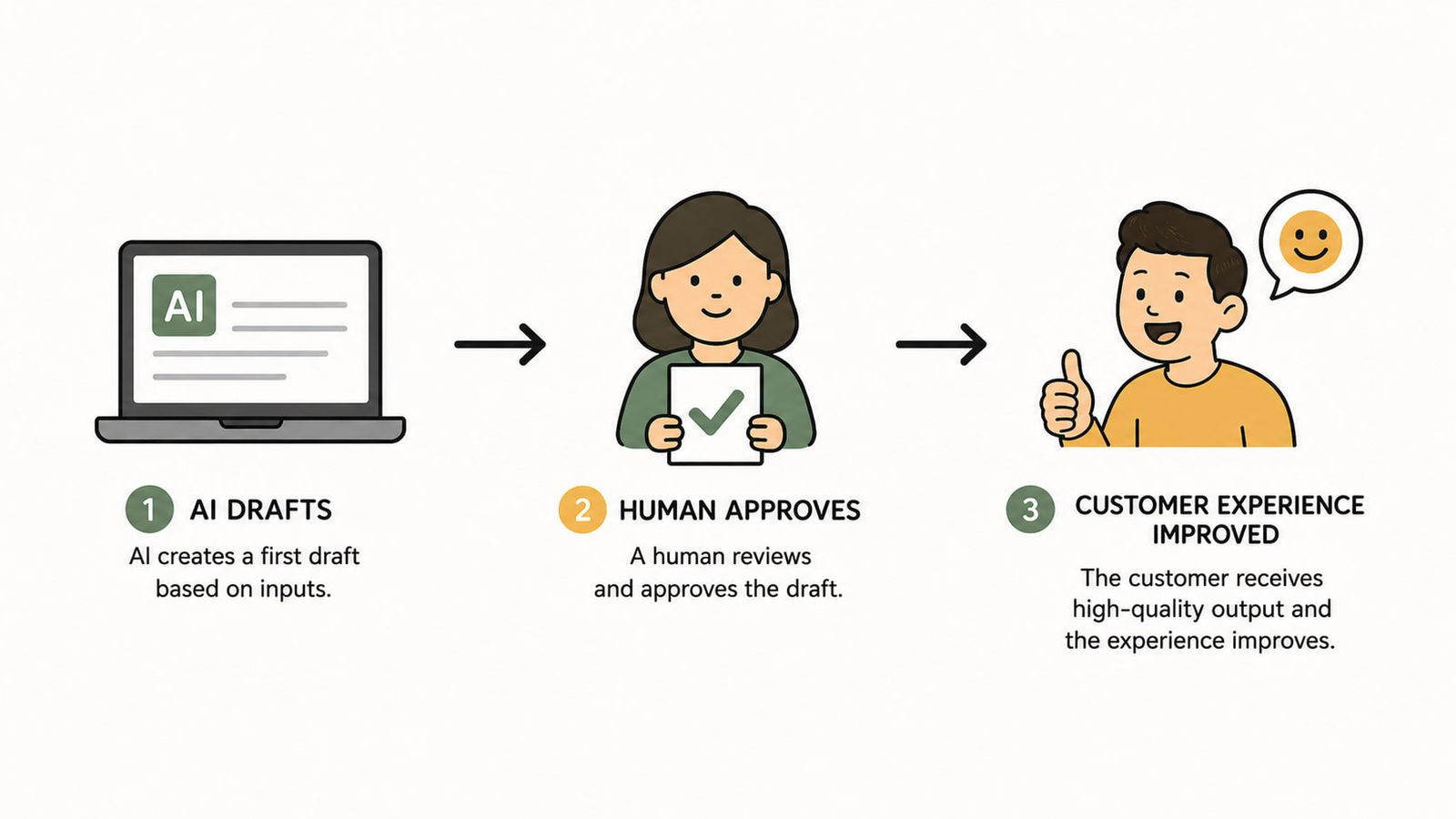
Humans stay in the workflow. Not as an optional override, but as a required step. The AI drafts, and the human reviews and approves before anything goes out. This is the difference between "AI-assisted" and "fully automated," and it's the difference between customer interactions that feel personal and ones that feel robotic.
The human improves the output. When a rep reviews an AI-drafted response, they can add a specific detail, adjust the tone for a customer they know, or catch something the AI missed.
The result is speed plus quality. The customer gets a fast, accurate, professional response. Your rep spent two minutes instead of twenty. And the customer doesn't know how the sausage was made. They just know someone got back to them quickly with exactly what they needed.
This approach is explained in detail in HyperRep's article on making AI feel more human. The short version: automation without human involvement damages trust. Human involvement without automation creates bottlenecks. Together, done right, they drive the outcome you're looking for.
Why This Is Hard to Get Right
There's a reason most companies haven't figured this out yet. Building a human-in-the-loop AI workflow requires more work than total automation.
You need clean, accurate pricing and service data that the AI can actually use. You need to train the system on your specific business: how you quote, how you communicate, the edge cases your team runs into. You need a clear process for when a rep approves, when they edit, and when they stop the automated flow and pick up the phone. And you need to maintain it. When your pricing changes, when you add a new service, when something isn't working, the system needs to be updated.
Most businesses that attempt AI automation skip this step. They find a tool, set it up in an afternoon, and let it run. Then they wonder why customers are complaining or deals are falling apart.
The businesses that build this the right way end up with something powerful: a team that can respond to every lead within five minutes, quote accurately on the first touch, follow up on a consistent schedule, and never let a deal fall through the cracks because someone was busy or forgot.
HyperRep Is Built on This Model
Every part of HyperRep's platform is designed around the human-in-the-loop framework. AI drafts every response. Humans approve before anything sends. Nothing goes to a customer without someone's eyes on it.
We also handle the hard part. The setup, the training, the maintenance. So your team gets the results without building the infrastructure from scratch.
If you're serious about response speed, close rates, and customer experience, and you want to see what this looks like for your specific business, learn more.